08069841500
 support@drpratim.com
Follow Us :
08069841500
support@drpratim.com

Laughter has a quiet magic of its own. Sukumar Roy captures this beautifully in his playful poem “আহ্লাদী,” where joy rises effortlessly through light-hearted words — হাসছি মোরা হাসছি দেখ, হাসছি মোরা আহ্লাদী. There is no deep reason, no grand message — just pure, spontaneous laughter. And perhaps that is exactly the point. William James once said, “We don’t laugh because we’re happy – we’re happy because we laugh.” Modern science now echoes what literature has long hinted at: laughter itself can shape our emotions, reduce stress, and improve well-being. Beyond medicines, diets, and exercise, laughter is emerging as a simple yet powerful supportive therapy—especially for individuals living with chronic kidney disease or undergoing haemodialysis. Let’s explore what scientific research says about laughter therapy, especially for kidney patients.

Laughter therapy is a structured approach using laughter and humour to improve physical, psychological, and social well-being. It includes activities such as:

Unlike ordinary joking around, laughter therapy in clinical studies is often guided by trained facilitators and applied in consistent sessions. (Xie et al.,2023).
Although laughter therapy has been studied in many health conditions, several systematic reviews confirm real health effects:

➤ General Health Findings
➤ Outcomes in Chronic Illness
This is the most exciting part — research has specifically investigated laughter in the context of hemodialysis patients:
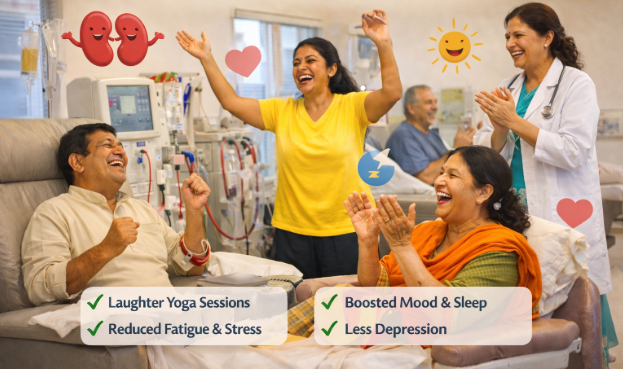
✔ 1. Laughter Yoga Improves Comfort and Treatment Experience
A randomized controlled trial found that laughter yoga significantly increased disease acceptance, comfort levels, and treatment adherence among hemodialysis patients compared to those who did not participate. This means patients were more psychologically equipped to cope with their dialysis routines (Bal et al., 2025).
✔ 2. Improved Fatigue and Well-Being
A clinical study published in Journal of Research in Medical Sciences found that humor therapy significantly reduced fatigue in chronic kidney disease patients undergoing hemodialysis. Because fatigue is a common and debilitating symptom in these patients, this outcome is both meaningful and encouraging (Sahebkar et al., 2026).
✔ 3. Systematic Evidence on Laughter Yoga Benefits
A broader systematic review reported that laughter yoga showed potential improvements in quality-of-life measures — including mood, sleep quality, and depression — in patients receiving haemodialysis, though results vary and more high-quality trials are recommended (Li et al., 2024).
✔ 4. Laughter Therapy May Reduce Depression
Another randomized controlled trial in haemodialysis patients looked at the effect of group laughter sessions and found significant reductions in depressive symptoms compared to controls, suggesting laughter therapy may support mental health in this population (Bennett et al., 2020).
While the exact biological mechanisms are still being studied, laughter appears to:
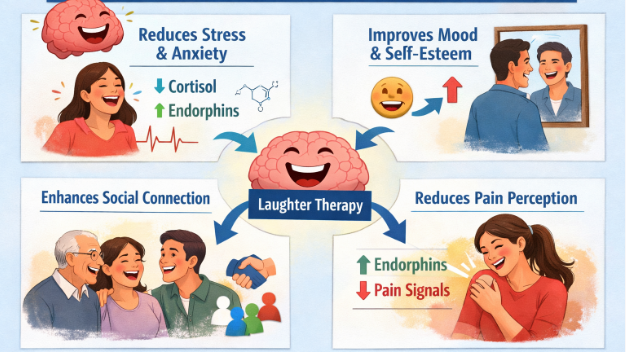
These effects are thought to be linked to psychological shifts and changes in hormones like endorphins and stress-related chemicals, although more mechanisms are being explored by scientists (Ferner et al., 2013).
Living with kidney failure and undergoing regular dialysis can be physically exhausting and emotionally draining. Scientific studies suggest that laughter therapy:
🌈Provides a low-cost, low-risk complementary intervention
🌟Enhances emotional well-being and social interaction
🌈 May reduce fatigue and depressive symptoms
🌟Can be easily incorporated into dialysis routines
For any kidney-related concerns, please feel free to contact us.
Laughter is not just a fleeting moment of joy — it is a gentle, scientifically supported therapy that helps make life with kidney disease easier and brighter. While it can never replace treatments like dialysis or medicines, laughter adds a humane and healing touch to care, reminding patients that smiles, too, can be part of the journey toward better health.

© 2025, Dr. Pratim. All Rights Reserved. Powered By NCIL IT Team